
The 2026 NBA Finals proved what great sports moments still do better than almost anything else in media: they concentrate attention, accelerate culture, and create value far beyond the broadcast.

In a market where audiences are harder to reach and even harder to hold, live sports remain one of the few environments where scale, emotion, social conversation, celebrity, and brand relevance can compound in real time.
But the biggest opportunity for marketers is not simply buying into sports. It’s being ready for what sports can become. At Crossmedia, we see sports as a connected investment ecosystem, not a standalone sponsorship or media placement. The brands that win are not always the ones that spend the most. They are the ones with the right portfolio, the right cultural timing, and the operational readiness to move when a moment breaks open.
This year’s Finals offered three lessons for marketers building sports strategies in a fragmented media landscape.
1) Sponsorship Rewards The Brands Already Positioned To Move
Now begins the process by which every NBA, Knicks, and Spurs sponsor will assess the value they received during a memorable NBA Finals. The biggest winners will be the brands that made their investments years ago, when both teams were at the bottom of the standings—a reminder that sponsorship strategy is not about predicting outcomes. It is about building portfolios positioned to benefit when lightning strikes. This year, everyone was handed a cultural multiplier: the Knicks returning to the Finals, an explosion of celebrity interest, a new 22-year-old global phenom arriving on basketball’s biggest stage, and New York flexing its media might.
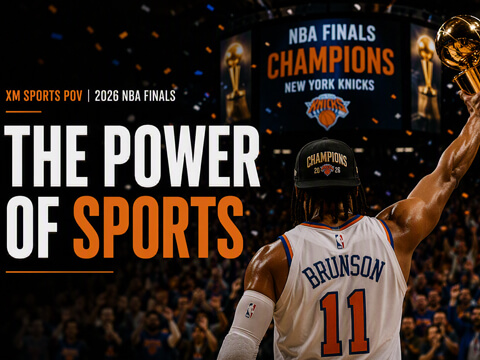
But investment alone is not enough. The brands that won biggest were not just bought in; they were ready. They had creative built and a plan in place to move the moment the final buzzer sounded. Nike dropped the Knicks championship commercial before the confetti settled. Verizon had OOH live across New York within hours. None of that happens through scrambling. It happens through preparation.
The numbers reflect just how big the stage was. The NBA Finals averaged more than 20 million viewers per game, more than double last year. Game 5 averaged 24.5 million viewers and was the most-watched NBA Game 5 in more than 25 years.
On social alone, the 2026 Finals generated 9.6 million posts and 163 million engagements, up 52% and 12%, respectively, from the 2025 Finals. Every partner already attached to either team suddenly benefited from what amounted to a scarcity premium. Their logos did not get bigger; the moment became bigger, and therefore their value did as well.
Sometimes the best ROI in sponsorship is not created by activation alone. It is created by timing and the readiness to capitalize on it when it arrives.
Takeaway: Moments like Knicks vs. Spurs do not happen often, and they are impossible to manufacture. Marketers should treat sponsorship like a portfolio, not a prediction market. The brands that win are the ones positioned before the moment arrives and prepared to move when it does.
2) Ratings Narratives Shift Faster Than Sports Value
Following the 2024–25 NBA season, the marketing conversation around the NBA focused on regular-season ratings being down 2% and Finals viewership down more than 8%. The conversation feels completely different now, and the NBA Finals are only part of the reason why.
With new media rights agreements in place for the 2025–26 season, NBA regular-season ratings were up more than 16% this year. Round 1 was the most-watched first round this decade, punctuated by Game 7 of the 76ers-Celtics series, which was the most-watched first-round Game 7 in NBA history. And then, of course, sports gave us Knicks vs. Spurs in the Finals.
In an era of fragmented attention and infinite content options, sports remains one of the last true appointment-viewing experiences: the rare thing people not only tune in for themselves but actively pull others toward.
Brands that recognize this invest heavily in sports media and sponsorships, allowing them to engage fans in ways traditional media alone cannot. In doing so, they are buying into one of the few remaining cultural connectors at scale.
Takeaway: Marketers should be careful not to mistake a short-term ratings narrative for a long-term audience truth. Live sports still has rare power to aggregate attention, but the value is increasingly shaped by distribution, cultural momentum, social amplification, and the specific moments that turn a game into a shared event. Sports investment should be evaluated across that full ecosystem, not by one season’s headline.
3) Athlete Influence Is Becoming A Global Media Channel
Every generation has a player who fundamentally expands the NBA’s global footprint: Yao Ming deepened the NBA’s connection to China. Dirk Nowitzki helped accelerate its relevance in Europe. But what made those players transformative was as much about timing as talent. They arrived when the infrastructure existed to carry their story to new audiences.
Victor Wembanyama arrives at a different moment entirely, and he’s only 22 years old.
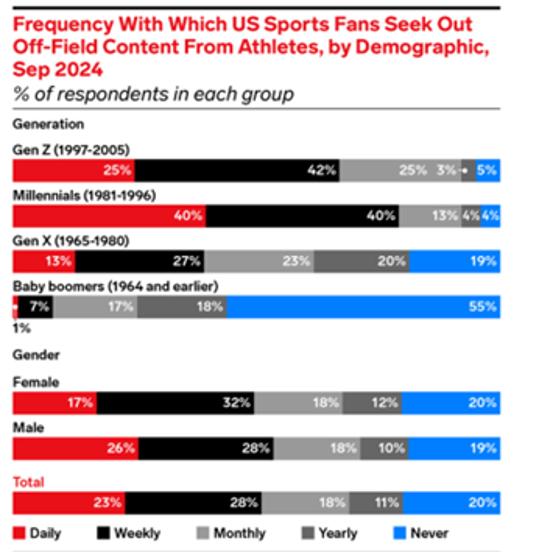
The relationship between fans and athletes has fundamentally changed. Following athletes has become a habit in its own right. It is not a passive byproduct of watching games anymore. Fifty-one percent of U.S. adults actively seek out athlete content on a daily or weekly basis. Thirty-three percent say they started following a new athlete in the last year alone. Among Gen Z, 80% follow an athlete on social media.
That is the ecosystem Wembanyama is stepping into, and it feels different. He is arguably the first internationally born, globally native NBA superstar, already driving massive increases in international viewership, jersey sales, and digital engagement. He was second to LeBron James in generating more than 2.4 billion views across the NBA’s social and digital platforms this season. His highlights reach fans who have never watched an NBA game.
For brands, that’s a very different commercial proposition, one built around global attention, social behavior, and athlete-led media.
Takeaway: Marketers should evaluate athlete influence the same way they evaluate modern media: by audience quality, platform behavior, cultural relevance, and global reach. The next generation of stars will not be defined only by championships or MVP awards, but by their ability to move attention across borders, feeds, formats, and fan communities.
BONUS: In Sports, Fandom Beats Borrowed Fame
Sports has always attracted celebrities, but New York felt different throughout these playoffs. Celebrity row felt like true, all-in sports fandom. If sports sponsorships can help humanize brands, they proved capable of doing the same thing for NYC’s biggest stars. How could you not feel like Timothée Chalamet, Ben Stiller, Spike Lee, and Tracy Morgan were like any other lifelong Knicks die-hard, riding every emotional high and low? If sponsors received millions in media exposure during the Finals, these Knicks mega-fans received even more. To the benefit of the NBA, they took us all along for the ride.
Ben Stiller turned his courtside presence into a mini documentary. Timothée Chalamet’s NBA Finals courtside appearances generated 6.2 million engagements, roughly equivalent to half the engagement of his Golden Globes win. By measurable standards, sitting courtside at the Finals became one of the highest-performing media moments for his personal brand.
Takeaway: In sports, borrowed fame is less powerful than visible, authentic participation. The most effective brand and talent integrations will feel less like endorsements and more like proof of fandom: present in the moment, emotionally invested, and credible to the community watching.
Sources:
Pathlabs, YouGov, Next Big Think, Harris Poll, Nielsen, Media Village, Sports Business Journal, AP News, NBA.com, Forbes, eMarketer, Ad Age, Morning Consult